In 2026, email deliverability is no longer a marketing afterthought—it is an unforgiving engineering boundary. Major inbox service providers like Google, Microsoft, and Yahoo enforce strict spam thresholds (0.3% complaint ceiling and sub-2% hard bounce tolerances). Exceeding these tolerances triggers immediate domain throttling or permanent blacklisting.
Yet, for years, email verification tools have operated as opaque “black boxes”: you drop in a list of emails, wait an unpredictable amount of time, and receive cryptic status tags with zero transparency into what happened during the verification handshake.
At MailVeri, we engineered our platform on the principles of speed, distributed scalability, and radical transparency. In this visual guide, I will walk you through the four core pillars of the MailVeri application—from our live telemetry dashboard to our 1,000,000-row batch engine, real-time single verification pipeline, and autonomous AI agent integrations.
Architectural Invariants of MailVeri
99%+ verification precision across Google Workspace, Microsoft 365, and custom domains, transparent 8-point deliverability telemetry, zero credits charged for unknowns, and native Model Context Protocol (MCP) support.
1. The Deliverability Command Center: Dashboard & Analytics
The MailVeri Main Overview Dashboard is engineered to serve as your mission control for list hygiene. Unlike traditional services that bury critical metrics inside buried sub-menus, MailVeri surfaces your entire deliverability posture at a glance.
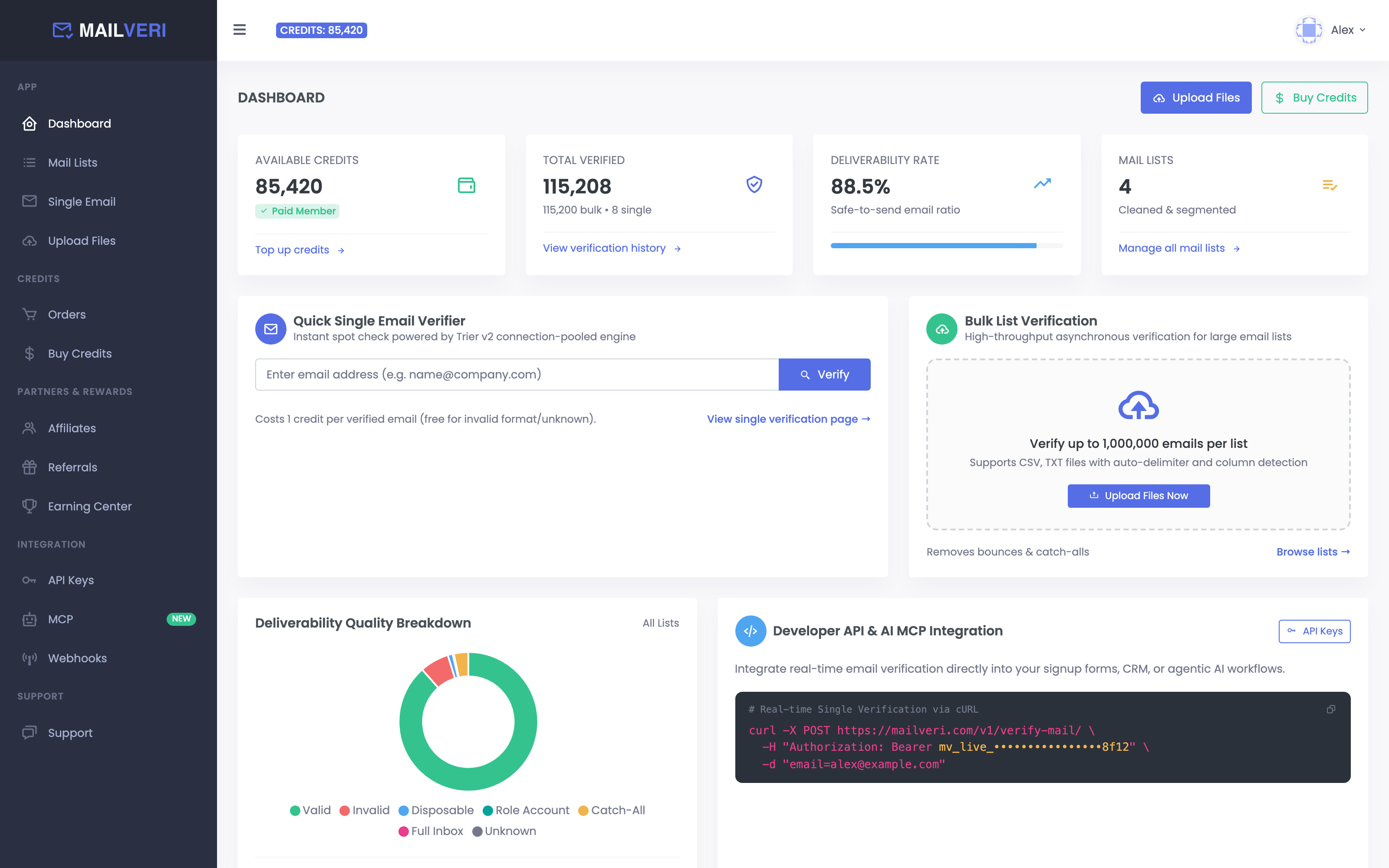
Key elements highlighted in the Overview interface include:
- Deliverability Distribution Donut: A multi-color breakdown categorizing verified contacts into Valid (green), Catch-All (purple), Disposable (orange), Role Account (yellow), and Invalid (red). On average, unfiltered B2B lead lists contain 15–25% toxic or dead addresses.
- Real-Time Credit Balance: Credits never expire on MailVeri. Furthermore, under our fair-billing model, unresolvable greylist errors and skipped custom routing are completely non-billable—you only pay for conclusive deliverability verdicts.
- Volume & Throughput Counters: Visual telemetry showing total emails scanned, active jobs in the queue, and real-time processing speeds.
- Recent Verification Activity: A live audit log tracking single verifications, batch completions, and API key token transactions.
2. High-Throughput Bulk List Verification: Up to 1,000,000 Emails
While single verification is critical for live web forms, the heavy lifting of outbound marketing, agency operations, and CRM migration takes place in bulk. MailVeri’s batch processing queue is built to handle files with up to 1,000,000 emails per list without timeouts, socket leakage, or server memory crashes.
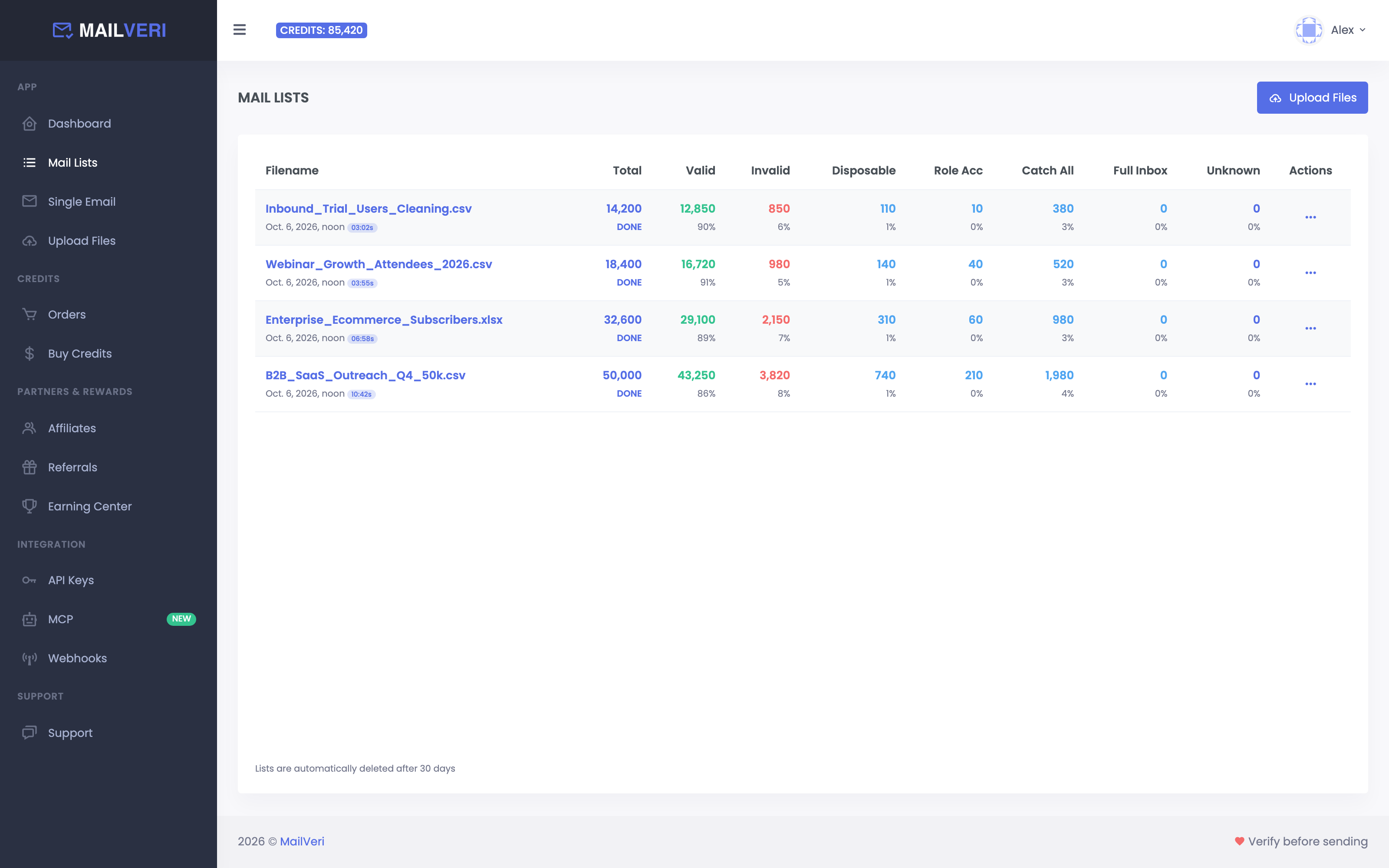
Our bulk verification pipeline combines three core stages:
- Fast-Path Verification (Google & Microsoft): Google Workspace and Microsoft 365 account for approximately 85% of corporate B2B inboxes. MailVeri uses high-concurrency verification pipelines to validate Google Workspace and Microsoft 365 mailboxes with 99%+ accuracy and fast list turnaround.
- Distributed Worker Fleet: For long-tail domains, self-hosted Postfix servers, and specialized ESPs, our asynchronous batch verification engine executes live SMTP mailbox checks with intelligent rate-limit handling. If a remote mail server issues a
421 Too Many Connectionsdeferral, MailVeri automatically respects server cooldown thresholds while keeping your batch turnaround fast and reliable. - Automated Smart Export: When a list completes, MailVeri automatically partitions the dataset into three ready-to-use CSV files: Safe to Send (100% Valid), Risky / Catch-All (for separate secondary warmup campaigns), and Excluded (Invalid, Disposable, Full Inboxes). You can import the clean file directly into Instantly, Smartlead, HubSpot, or Klaviyo with zero manual spreadsheet cleanup.
Developers can also submit massive batch files programmatically via our REST API:
import httpx

API_KEY = "YOUR_MAILVERI_API_KEY"
BASE_URL = "https://api.mailveri.com"

# Submit a 100,000-contact file for asynchronous verification
with open("q4_outreach_leads.csv", "rb") as f:
    response = httpx.post(
        f"{BASE_URL}/v1/verify-mails/",
        headers={"Authorization": f"Bearer {API_KEY}"},
        files={"file": ("q4_outreach_leads.csv", f, "text/csv")},
        data={"auto_start": "true", "name": "Q4 Enterprise Outreach"},
        timeout=60.0,
    )

task = response.json()
print(f"Batch task created: {task['task_id']} — Status: {task['status']}")
3. Point-of-Capture Protection: Real-Time Single Verifier
Preventing toxic emails from entering your database at the point of capture is exponentially cheaper than cleaning them after they have already poisoned your CRM. The Real-Time Single Verifier allows outreach reps, product managers, and developers to spot-check individual email addresses in under 500 milliseconds.
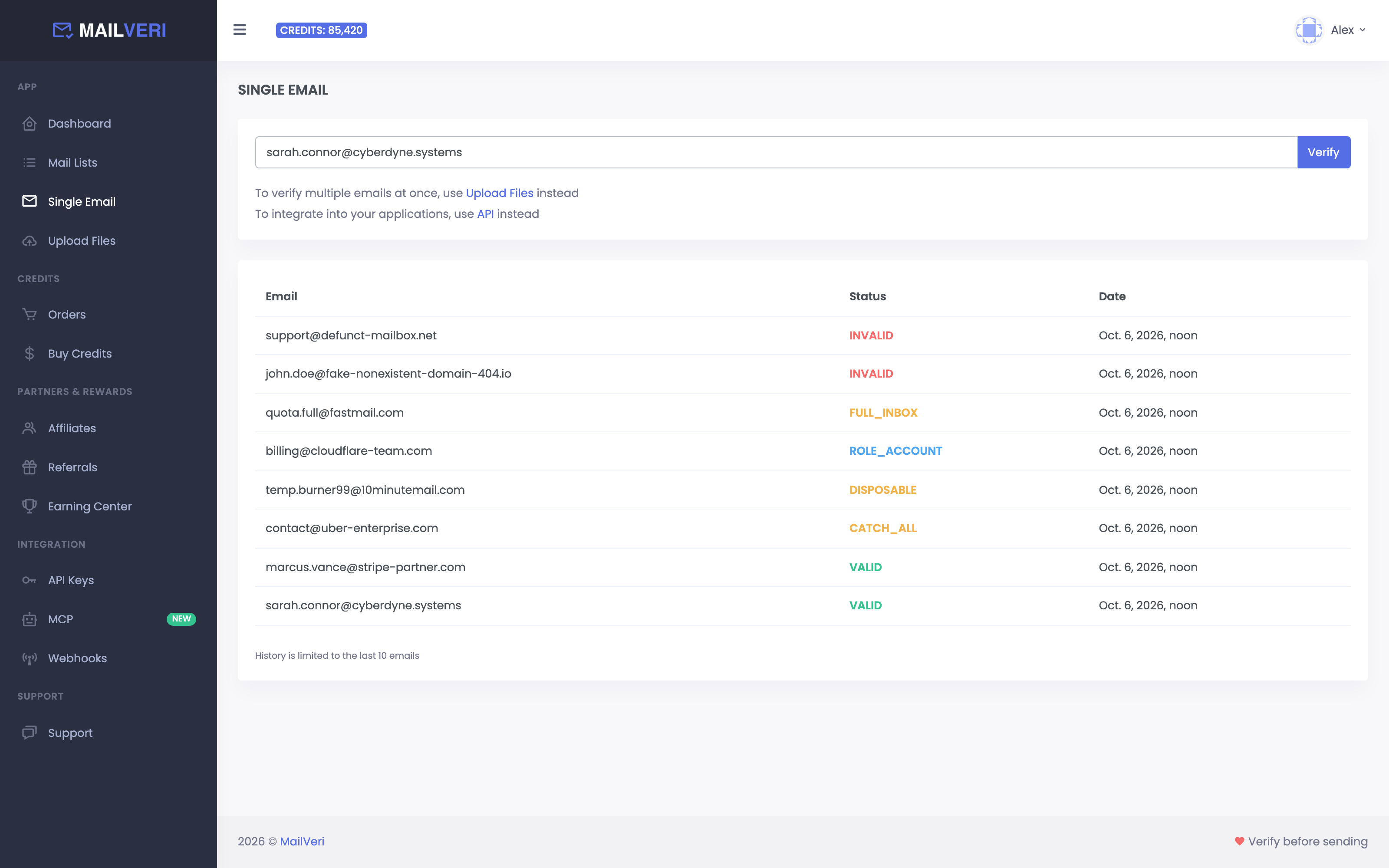
When you submit an email, MailVeri executes an 8-point diagnostic pipeline:
Conforms to RFC 5321/5322 syntax standards, invalid characters, and regex formats.
Queries DNS to ensure the recipient domain has active, configured Mail Exchange servers.
Connects to remote port 25 and checks RCPT TO deliverability without sending actual emails.
Probes non-existent mailboxes to detect server-wide wildcard accept-all configurations.
Cross-references against a continuously updated database of 120,000+ burner domains.
Flags generic department mailboxes (admin@, sales@, billing@, support@) that hurt open rates.
Detects 552/452 over-quota storage errors that lead to immediate delivery failure.
Applies ESP-specific rules (Gmail dot stripping, plus-addressing alias cleanup) to avoid duplicates.
Integrating single verification into your backend registration flow or checkout form takes three lines of code:
curl -X POST https://api.mailveri.com/v1/verify-mail/ \
  -H "Authorization: Bearer YOUR_API_KEY" \
  -d "[email protected]"
The API returns a clean, structured JSON response containing both high-level verdict and low-level diagnostic attributes:
{
  "error": 0,
  "message": "Verified [email protected] successfully",
  "status": "VALID",
  "email": "[email protected]",
  "mail": "[email protected]",
  "mx_records": [
    "mail.cyberdyne.systems"
  ],
  "is_smtp_valid": true,
  "is_catch_all": false,
  "is_disposable": false,
  "is_role_account": false,
  "is_full_inbox": false,
  "balance": 85419
}
4. Autonomous AI Workflows: Developer Hub & MCP Integration
The most transformative development in 2026 developer tooling is the rise of autonomous coding agents and agentic workflows. MailVeri is the first email verification platform to provide official, first-class support for the Model Context Protocol (MCP).
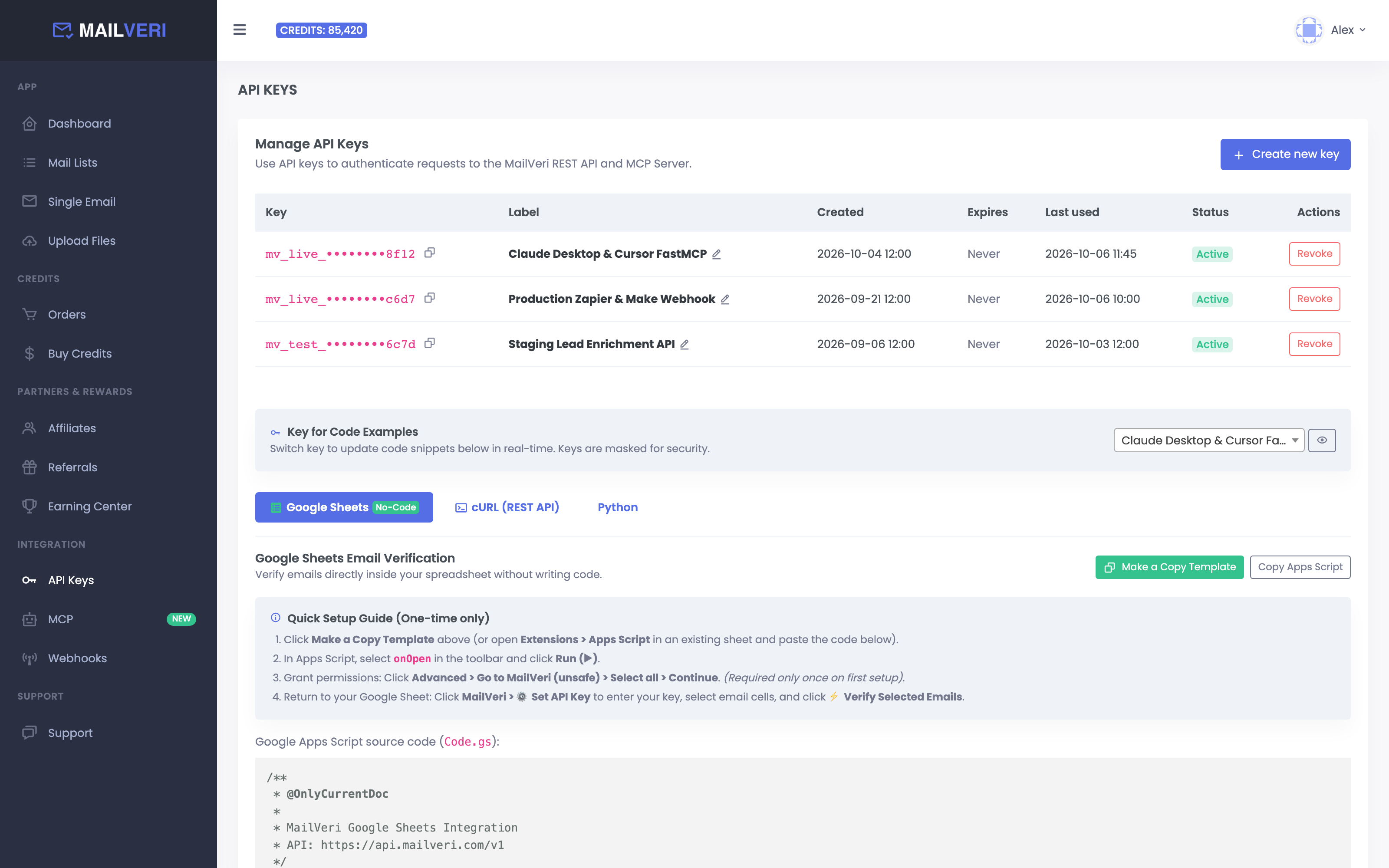
By connecting our MCP server to your development environment (Claude Code, Cursor, Windsurf, or Codex CLI), your AI assistants can invoke verification tools natively during script execution, lead scraping, or data pipeline builds:
{
  "mcpServers": {
    "mailveri": {
      "command": "uvx",
      "args": [
        "--from",
        "git+https://github.com/mailveri/mailveri-mcp",
        "mailveri-mcp"
      ],
      "env": {
        "MAILVERI_API_KEY": "YOUR_MAILVERI_API_KEY"
      }
    }
  }
}
Once configured, you can prompt your AI assistant in plain English:
“Review the scraped prospects inprospects.csv. Usemailveri_verify_emailto verify each email address, reject any disposable or invalid domains, and save the deliverable records toclean_prospects.csv.”
The agent automatically handles batching, rate-limiting, error retries, and file writing—reducing an hour-long manual cleaning chore to a 10-second command.
Summary: Best Practices for 2026 Outbound Deliverability
Maintaining high inbox placement requires consistent adherence to three fundamental habits:
- Scrub Lists Every 30 Days: B2B email lists decay at an estimated rate of 2.5% per month due to employee job changes, company rebrands, and domain expirations. Never send a cold campaign to a list that hasn’t been verified within the last 30 days.
- Isolate Catch-All Addresses: Catch-all domains accept all inbound emails at the SMTP gateway, regardless of whether a mailbox actually exists. Never blend catch-all emails into your primary outbound campaigns. Segment them into a separate warmup sequence with strict bounce monitoring.
- Layer Point-of-Capture with Bulk Audits: Use our single verification API on inbound lead forms to reject invalid emails before they enter your CRM, and run monthly bulk sweeps to detect decayed contacts.